

I haven’t been very active on here, mainly because I’ve been wrapped up in publishing my memoir, Can You Hear the Music? Following my last blog post, “In the Trenches,” I abruptly switched gears and decided to self-publish. My book launches Nov. 30, and the product is the absolute highest quality book I could have published.
But I would be remiss if I didn’t acknowledge the people who supported me along the way, providing editorial and design services, bringing my book up to industry standards. These people raised the quality of my work while teaching me tons about writing and publishing. I will list the individuals in the order of the design process.
My Publisher

First, I’d like to thank my publisher, Mad Engineer Press LLC, for coordinating the editing and cover design, for launching a killer marketing campaign, and for footing most of the bill.
Okay, truth be told, I’m Mad Engineer Press–I did all this. It may seem like a lot, but that’s the nature of self-publishing. In all honesty, I enjoyed the challenge of handling everything myself. To have the pieces come together so nicely is actually quite rewarding. I wouldn’t have been able to do this without some hefty fundraising and a decent day job though.
And let’s take a minute to recognize indie authors in general, whose collective wisdom helped me create my book seamlessly. The network of indie authors is amazing, and it is incredible how they lift each other up! I’m glad for the friends I’ve made through the process.
My Developmental Editor
Next, I’d like to thank Elizabeth DeNoma for her developmental edits on my manuscript. I approached Elizabeth on Reedsy in 2021 with a rough first draft, thinking it was missing something but I wasn’t quite sure what. Elizabeth helped me develop the characters in my story, identify places where dialogue was needed, and generally shape the narrative into a cohesive story line. As a first time writer, this step was essential, and working with Elizabeth prompted me to learn more about the craft. Her encouragement helped me continue through the lengthy process of writing the next draft, which turned out to be a much stronger draft.
My Line Editor/Copyeditor
I worked with the manuscript over the next year and a half. After editing until my head hurt, I decided to up my game and hire a professional line editor. As luck would have it, I met Lisa Rose in an online group for writers after one editor offered their services and then said they didn’t edit LGBTQ materials–this was a hard pass for me! Lisa stepped up and offered her services, and she turned out to be an awesome fit due to her additional interest in mental health. Lisa made my prose shine, turning “tell” into “show” and catching the occasional holes in my story. I enjoyed working with Lisa so much that I asked her to do the copyediting too! She’s a fantastic person and now a good friend 🙂
Interior Layout
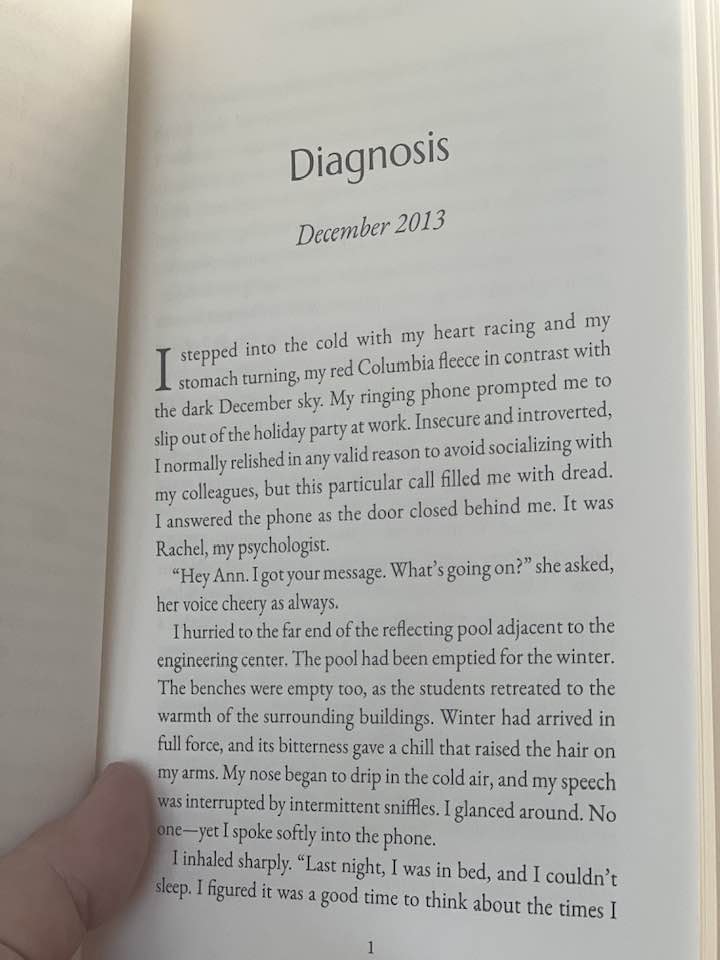
Okay, this is where I sort of cut corners and did the work myself using Atticus, which is a user-friendly program that does a “good enough” job with interior layout. Since I didn’t have any images or graphics and just needed a basic design for my book, Atticus was sufficient.
Proofreading
Once the interior was complete, I went back to Reedsy to find a proofreader. By sheer luck, I met Deirdre Stoelzle, who was a journalist with experience writing about traumatic events, including the Virginia Tech shooting. Deirdre was great to work with, but perhaps even more importantly, she connected me with renowned professor of psychiatry Frank Ochberg, who offered to read my book and later provided a review. Deirdre was great to work with, and I’m glad to have her support on this project.
Cover Design

The last component of the book is the cover design. I personally was looking for a design that captured the general themes of the book while conveying a sense of darkness. For this task, I reached out to Nuno Moreira, whose portfolio showed works that were abstract and some of which covered the topic of mental illness. I gave Nuno the freedom to develop designs, and one of the options–the one you currently see on the cover of my book–was perfect. In the image, you see a woman with a bare back and her arms around her, illustrating concepts of vulnerability and aloneness, and she is surrounded by music notes that are arranged in a chaotic manner, which convey a sense of distress befitting an episode of psychosis. The color scheme–whether intentional or not–is reminiscent of the University of Michigan’s Maize and Blue, and the dark blue with white flecks reminds me of winter, which has relevance to parts of the story. All in all, I think Nuno did a great job of providing me with a cover that is beautiful, reflects the content of the story, and will draw the attention of readers.
 A. E. Jeffers
Leave a comment